The Washington Monument: Forty Years of False Starts, Then the Tallest Building on Earth
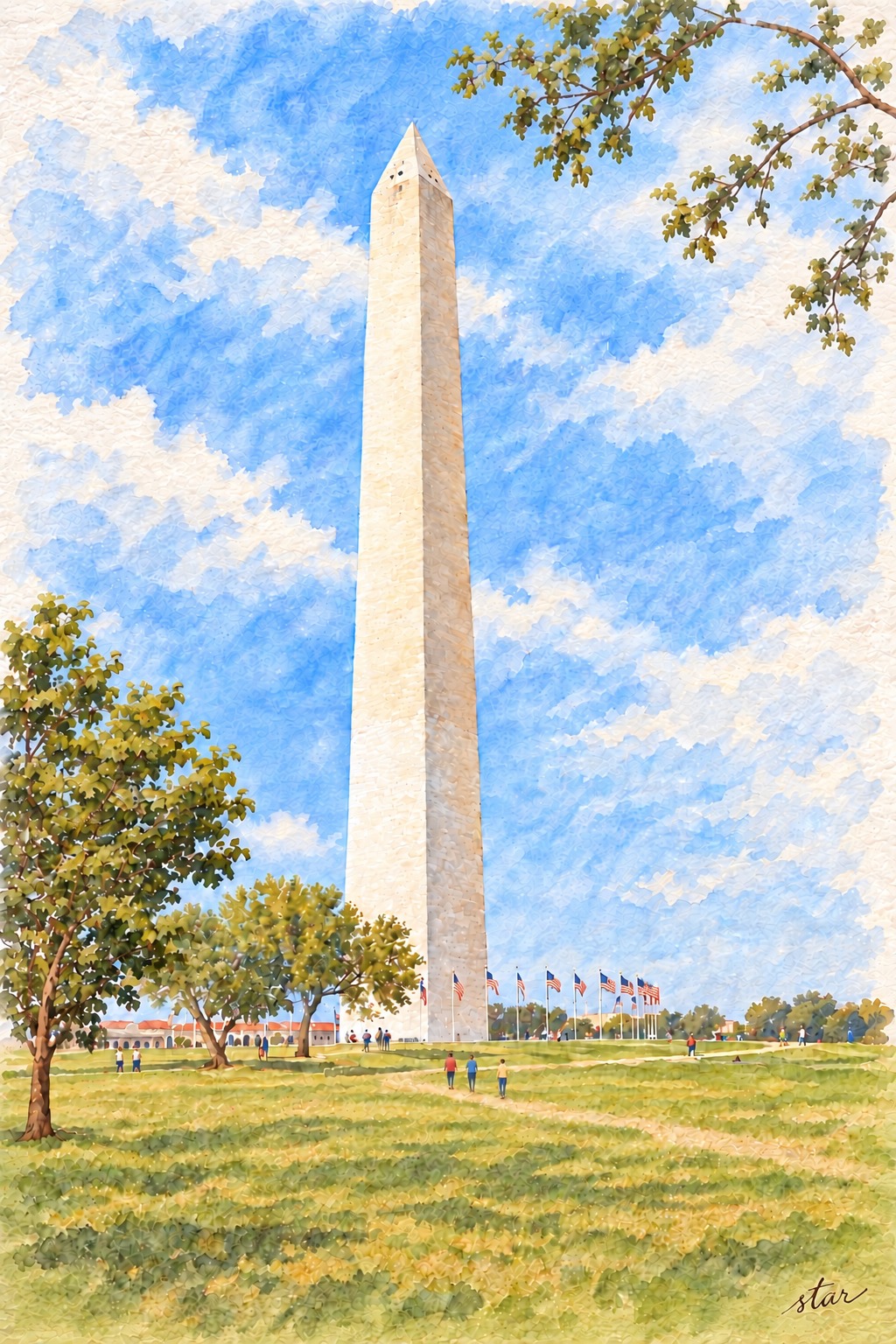
Original watercolour art illustration by Solomon Rokowsky.
L'Enfant's 1791 plan for the capital reserved the point where a line south from the White House crosses a line west from the Capitol for a monument to George Washington. It took until 1833 for anyone to organize the job: the private Washington National Monument Society set out to build something "unparalleled in the world," and after a decade of fundraising chose Robert Mills's design - a 600-foot Egyptian obelisk ringed by thirty 100-foot columns.
The cornerstone went in on July 4, 1848, before 20,000 people: President Polk, Dolley Madison, Alexander Hamilton's widow Eliza, and three future presidents - Buchanan, Lincoln and Andrew Johnson - all attended. Masons raised the shaft with derricks, block and tackle, reaching about 152 feet by 1854, when the money ran out.
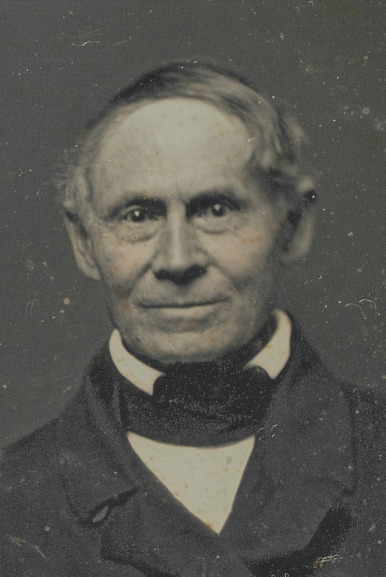
The embarrassing stump
What followed was twenty years of civic humiliation. In the early hours of March 6, 1854, members of the anti-Catholic Know-Nothing movement destroyed a commemorative stone donated by Pope Pius IX - the "Pope's Stone" - and the next year the Know-Nothings seized the Society outright, adding just two courses of rejected stone before collapsing. Congress walked away, Mills died in 1855, and the Civil War finished the stall. For two decades a 156-foot marble stump stood in the muddy fields west of the Capitol, doing more to embarrass the nation than to honor Washington. A priest quietly replaced the Pope's Stone in 1982.
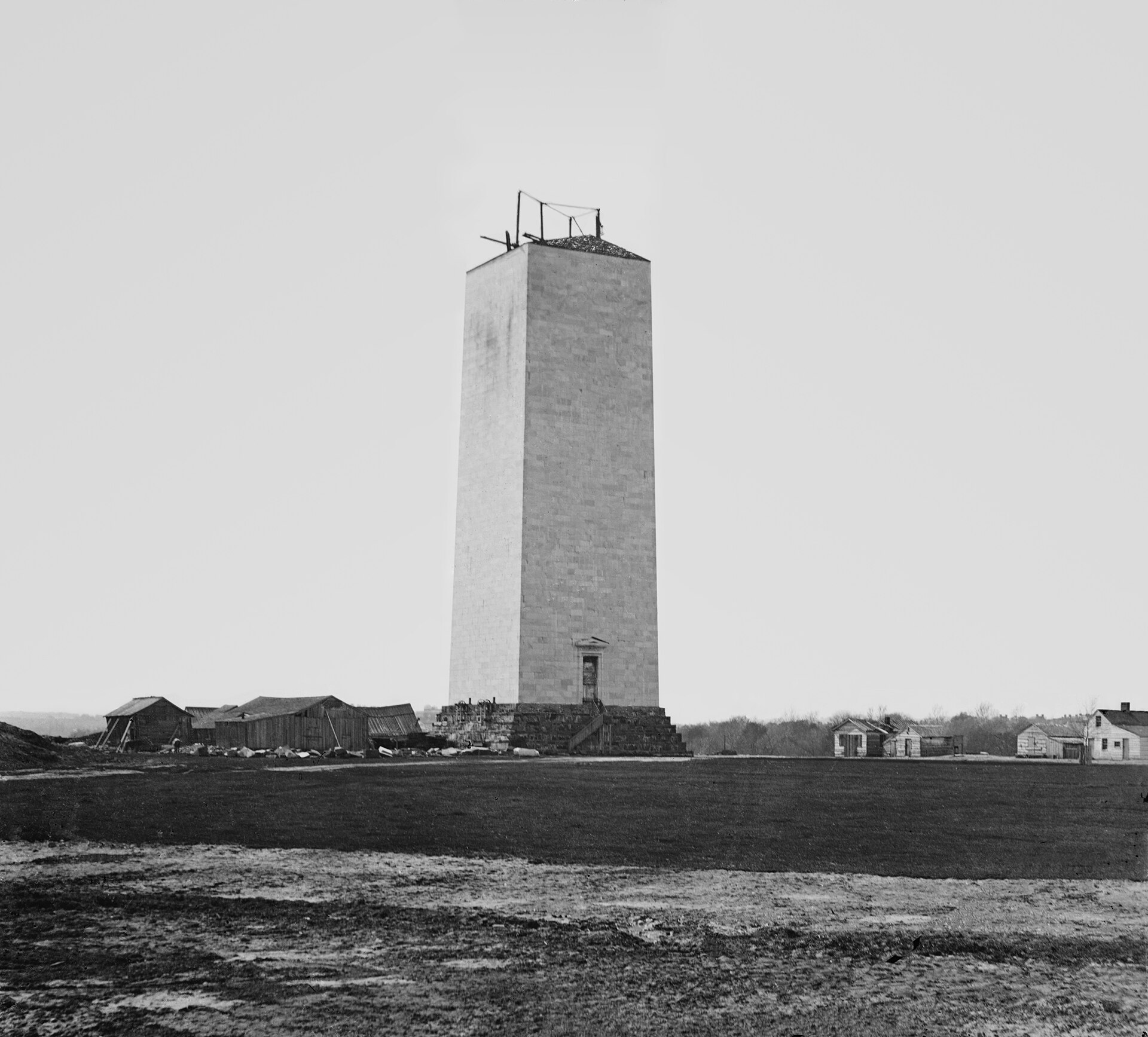
The unfinished stump around 1860. Photo: Mathew Brady, public domain, via Wikimedia Commons. Resized.
Casey finishes it
On July 5, 1876, the nation's centennial, Congress took over the project and handed it to Lt. Col. Thomas Lincoln Casey and the Army Corps of Engineers. Casey found the foundation inadequate for the enormous load, and spent four years rebuilding it before going up. The original quarry was long unavailable; stone from a second, then a third quarry went up instead, which is why the shaft shows three slightly different colors - the brown-streaked beltline a third of the way up is visible from the ground. The ring of columns was scrapped, the proportions fixed at ten times the base width, and the height settled at 555 feet, 5-1/8 inches.
On December 6, 1884, Casey set the 3,300-pound marble capstone and capped it with an 8.9-inch cone of aluminum - at a time when aluminum was as precious as silver - the largest single piece of aluminum yet cast. Its east face reads "Laus Deo" - praise be to God. The monument was dedicated on February 21, 1885, opened to the public on October 9, 1888, and until the Eiffel Tower rose in 1889 it was the tallest structure on Earth. Total cost from 1848 to 1888: $1,409,500.
The modern monument
The National Park Service took jurisdiction in 1933. Inside, the walls carry 193 commemorative stones from states, cities, civic groups and foreign governments - some visible on the elevator's descent. The monument has been closed and rebuilt repeatedly: Depression-era restoration in 1934, work in 1964, a restoration from 1998 to 2001, then closure from 2011 to 2014 after a 5.8-magnitude Virginia earthquake cracked the pyramidion, and again from 2016 to 2019 for a modernized elevator. In January 2026 it began carrying projection-mapped illuminations for the nation's 250th birthday.
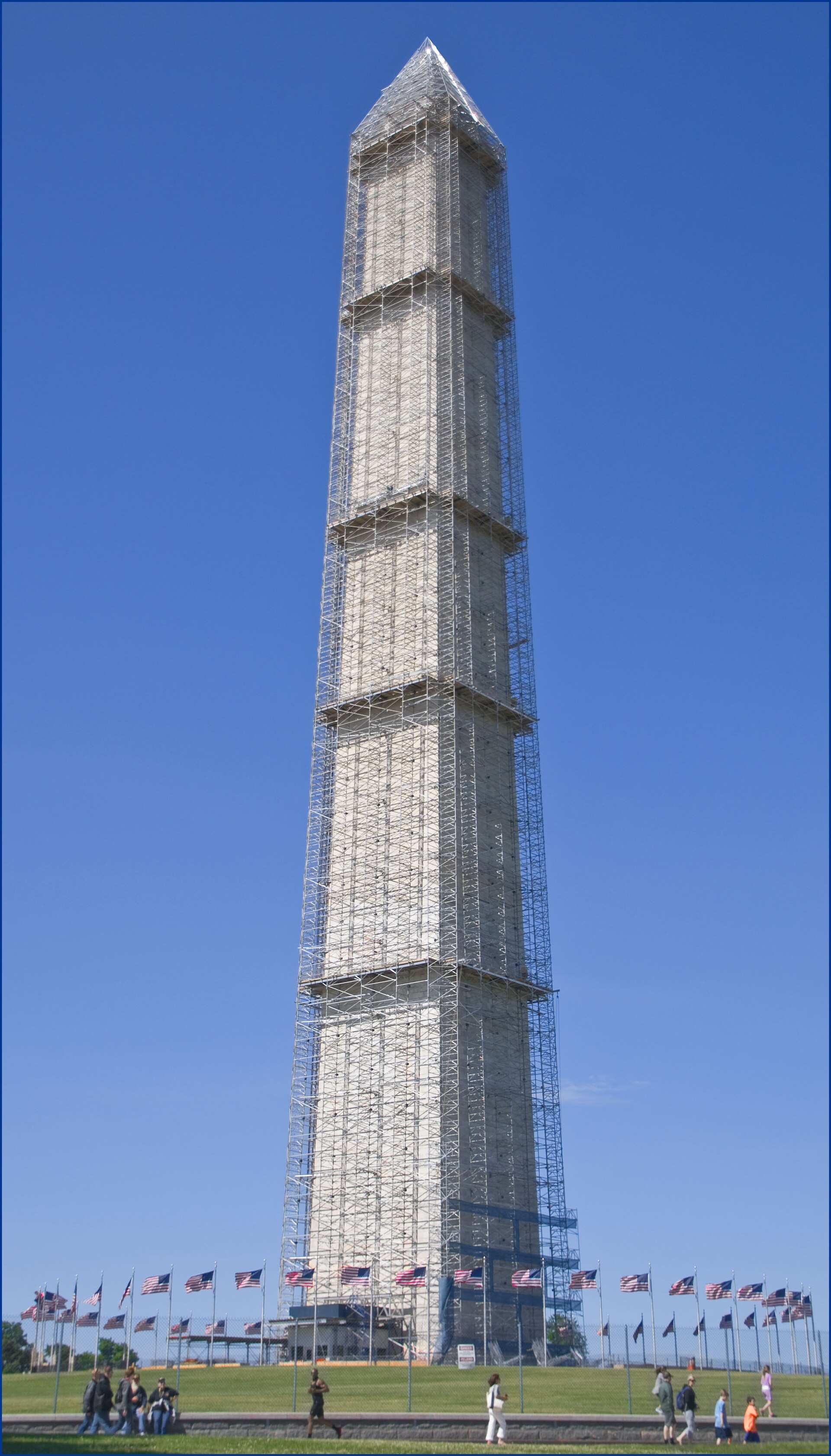
Wrapped in scaffolding for post-earthquake repairs, May 2013. Photo: Ron Cogswell, CC BY 2.0, via Wikimedia Commons. Resized.
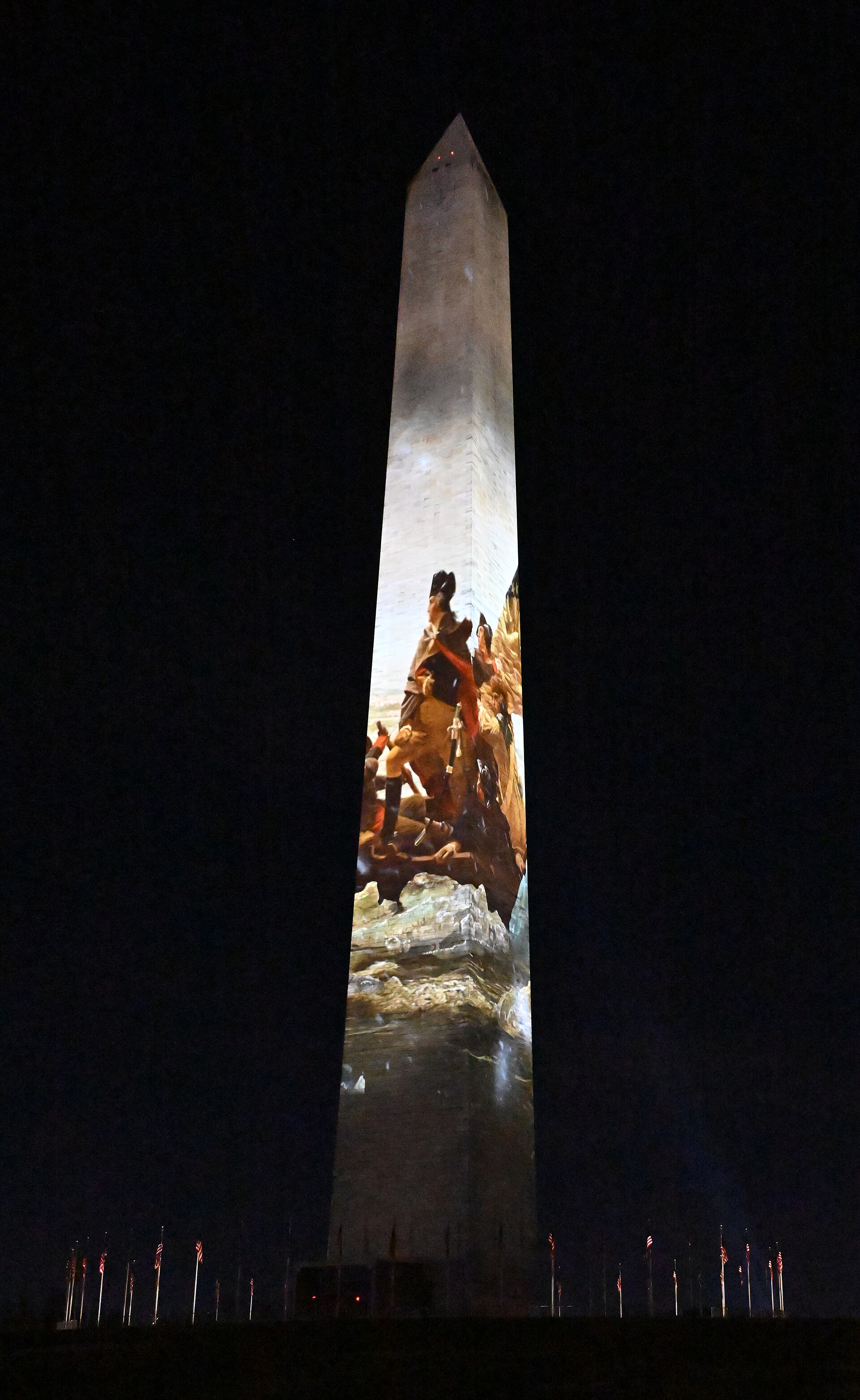
An America 250 projection on the shaft, January 2026. Photo: G. Edward Johnson, CC BY 4.0, via Wikimedia Commons. Resized.
Who owns the Washington Monument today?
The monument is owned by the United States and administered by the National Park Service, which has run it since 1933 as part of National Mall and Memorial Parks.
In the movies
For Spider-Man: Homecoming (2017), the monument's elevator rescue sequence was shot on sets at Pinewood Studios Atlanta, with background plates filmed in Washington - the monument on screen is largely a digital double. The Pelican Brief (1993) did come to town, filming at the monument among its Washington locations. The shaft is also a fixture of Washington establishing shots going back to Mr. Smith Goes to Washington in 1939.
Where can you eat or drink near the Washington Monument?
No food or drink is sold at the monument. The surrounding Mall has seasonal vendor trucks along the main cross-streets, and the nearest sit-down blocks are back toward the Smithsonian museums and downtown.
Visiting the Washington Monument
- Address: 2 15th St NW, Washington, DC 20024
- Hours: Daily, 9 AM-5 PM (last elevator up about 4 PM)
- Admission: Free, plus $1 reservation fee per ticket
Timed tickets are required for the elevator to the observation deck. Reserve online in advance; a small number of same-day tickets are released each morning.