The U.S. Capitol: Two Centuries of Building, Burning and Rebuilding
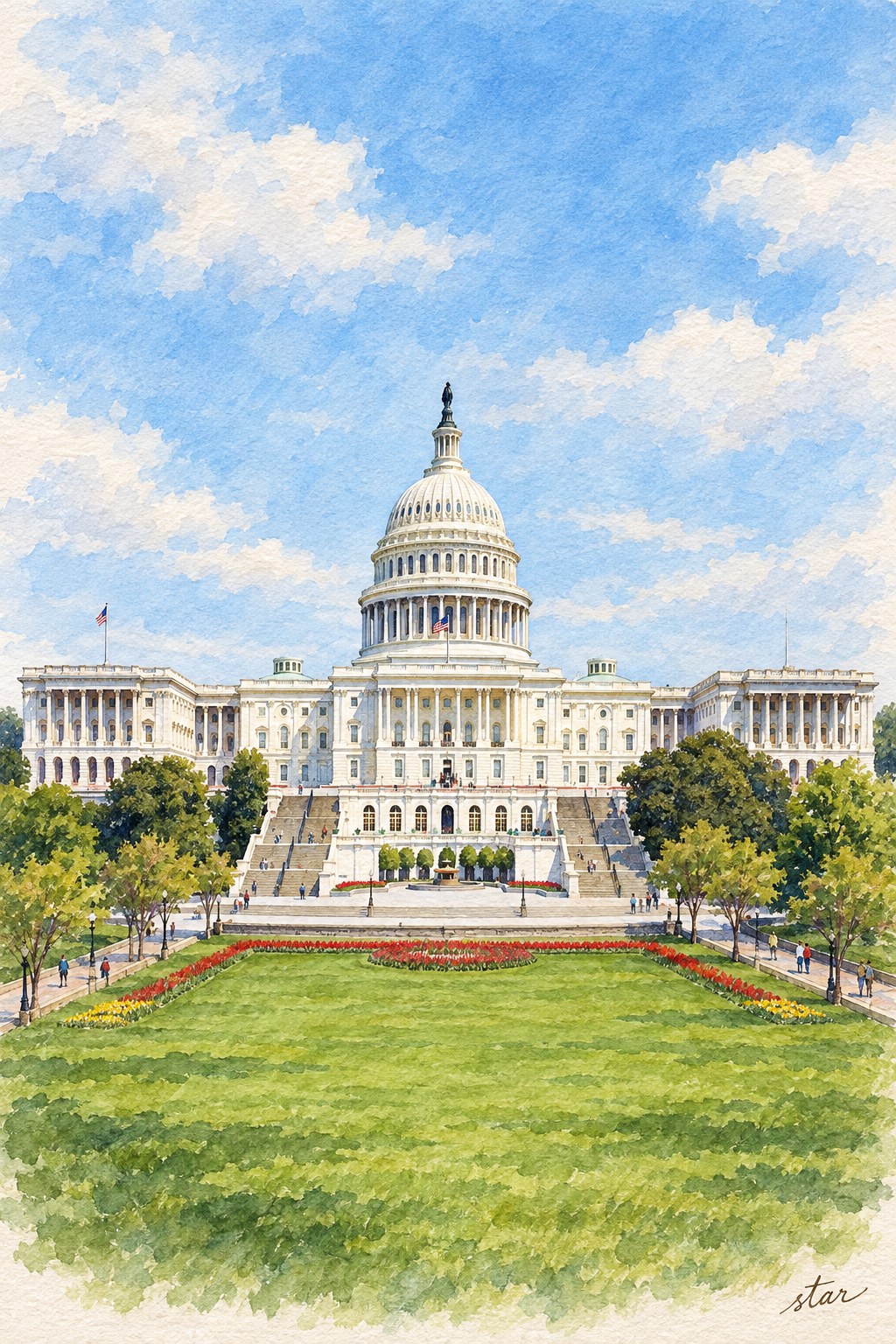
Original watercolour art illustration by Solomon Rokowsky.
When Pierre L'Enfant laid out the new federal city in 1791, he set the Congress House on Jenkins Hill, a rise he called "a pedestal awaiting a monument," and tied it to the President's House by the broad diagonal of Pennsylvania Avenue. After L'Enfant was dismissed in 1792, Thomas Jefferson ran a design competition for both buildings. The winning Capitol entry arrived late, in January 1793, from William Thornton, an amateur architect and doctor. George Washington praised its "grandeur, simplicity and beauty," and approved it that April. On September 18, 1793, Washington, wearing Masonic regalia, laid the cornerstone in a full Masonic ceremony, with a silver plate made by silversmith Caleb Bentley.
The building rose slowly, and much of it was raised by enslaved laborers hired out by their owners to the federal government, which paid the owners and housed and fed the workers. The Senate (north) wing was finished first, and on November 17, 1800, Congress held its first session in the Capitol - the Senate and House sharing the one completed wing. The House wing followed in 1811. For decades the building also doubled as Washington's largest Sunday church: Thomas Jefferson rode horseback to services in the House chamber, and worship continued there until after the Civil War.
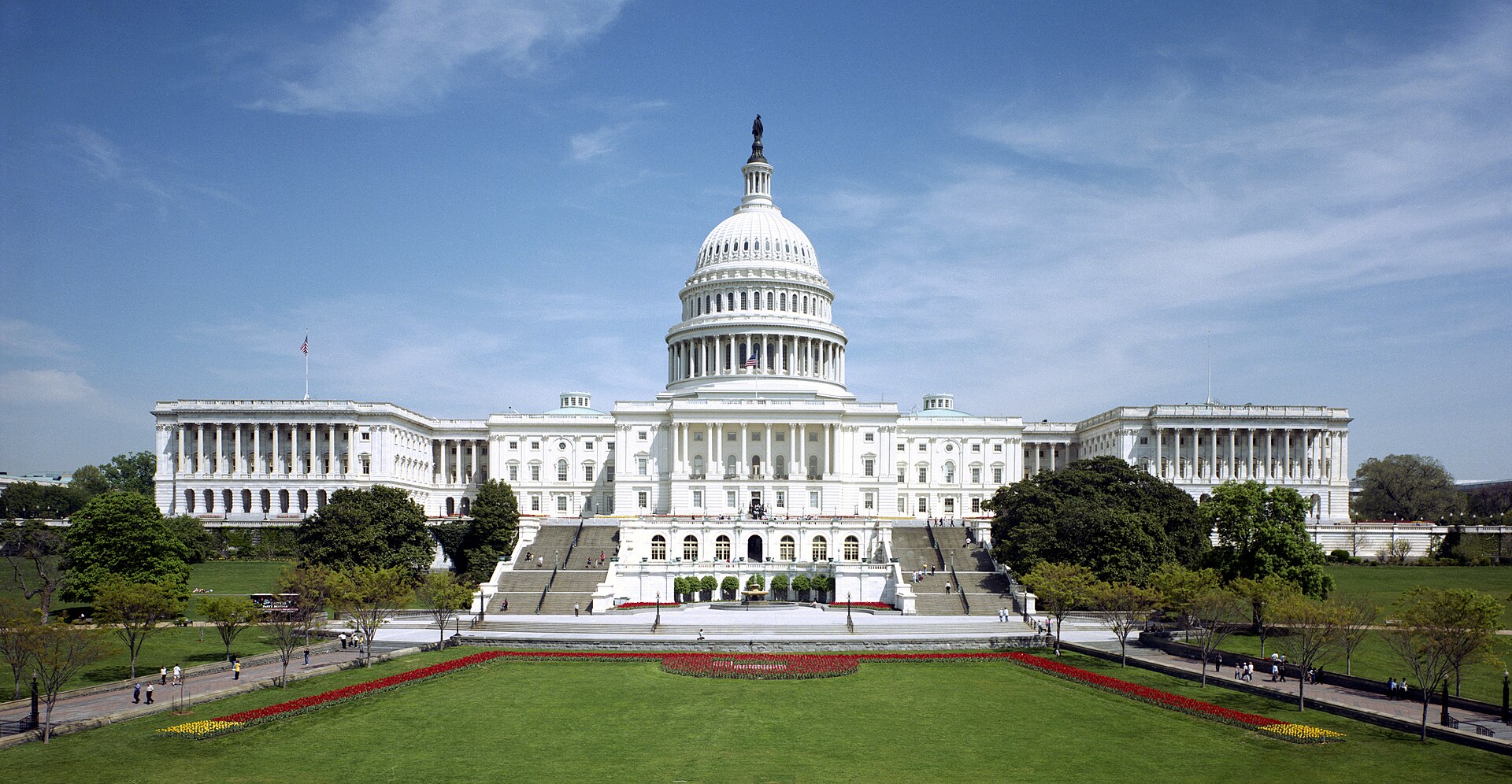
The west front of the Capitol today. Photo: Architect of the Capitol, public domain, via Wikimedia Commons. Resized.
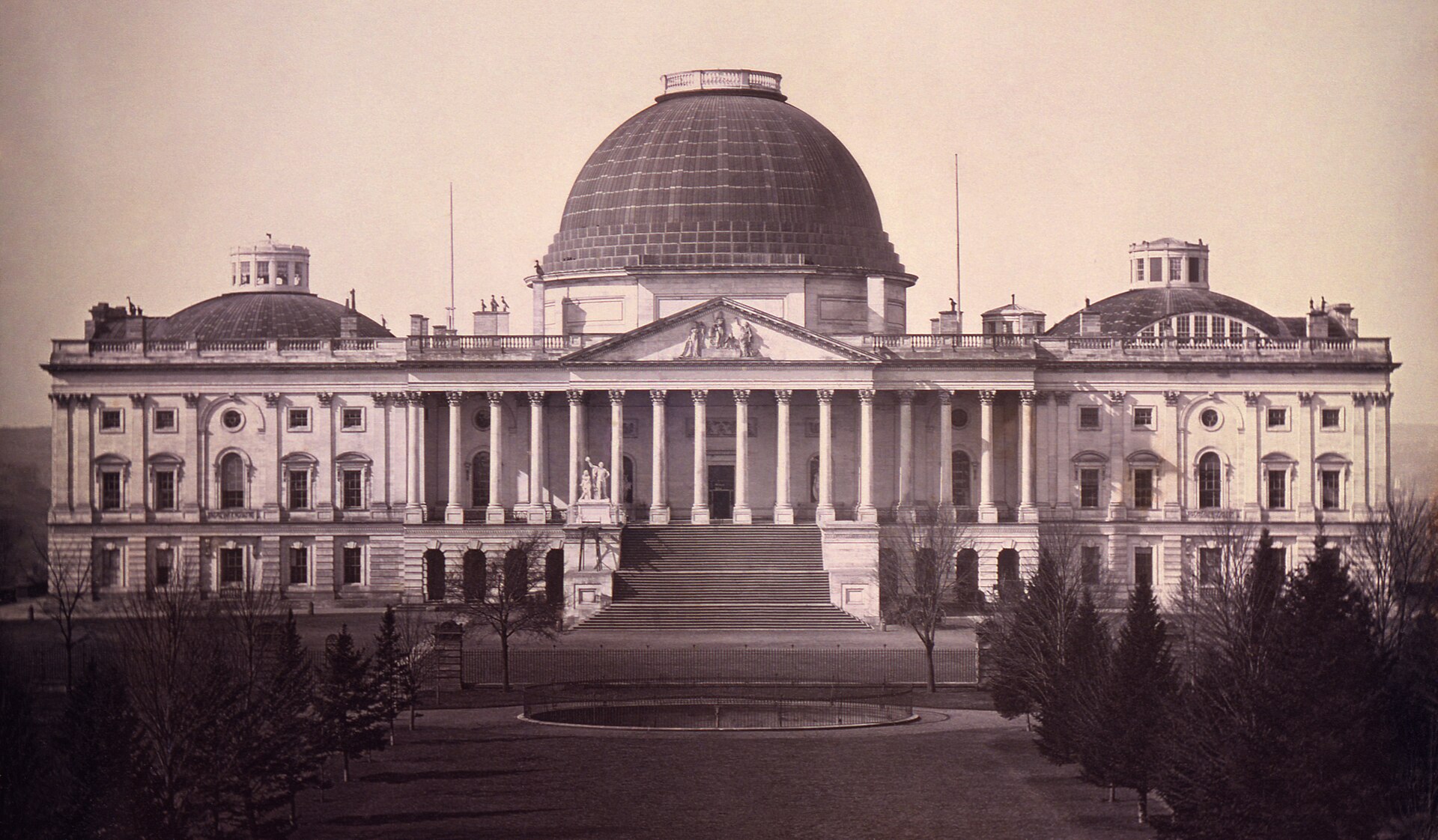
The Capitol in 1846, with the low copper-covered dome it carried before Thomas U. Walter's expansion. Daguerreotype by John Plumbe Jr., public domain, via Wikimedia Commons. Resized.
Burned, rebuilt, doubled
On August 24, 1814, British troops burned the Capitol during the War of 1812, leaving a blackened shell. Benjamin Henry Latrobe, who had already redesigned the interiors once, returned to rebuild, and Congress met in a temporary "Old Brick Capitol" while the work went on. Latrobe's successor Charles Bulfinch finished the center section, the Rotunda and the first low, copper-covered dome by 1826. Latrobe's vaulted Old Supreme Court Chamber - where the Court sat from 1810 to 1860 - survives on the ground floor as one of his finest rooms.
By 1850 the building had outgrown itself as new states sent new legislators. President Millard Fillmore gave the expansion to Philadelphia architect Thomas U. Walter, who added the present House and Senate wings - more than doubling the building's length - and then replaced Bulfinch's low dome, suddenly out of proportion, with the cast-iron dome we know today. Built from 1856 to 1866 for $1,047,291, the dome is two shells in one, with a great oculus opening onto Constantino Brumidi's fresco The Apotheosis of Washington. It weighs nearly nine million pounds of iron, cast by the Janes, Fowler, Kirtland and Company foundry, and in 1863 it was crowned by the bronze Statue of Freedom. The Capitol stands 288 feet to the top of the statue, runs 751 feet from north to south, and contains about 540 rooms and 658 windows.
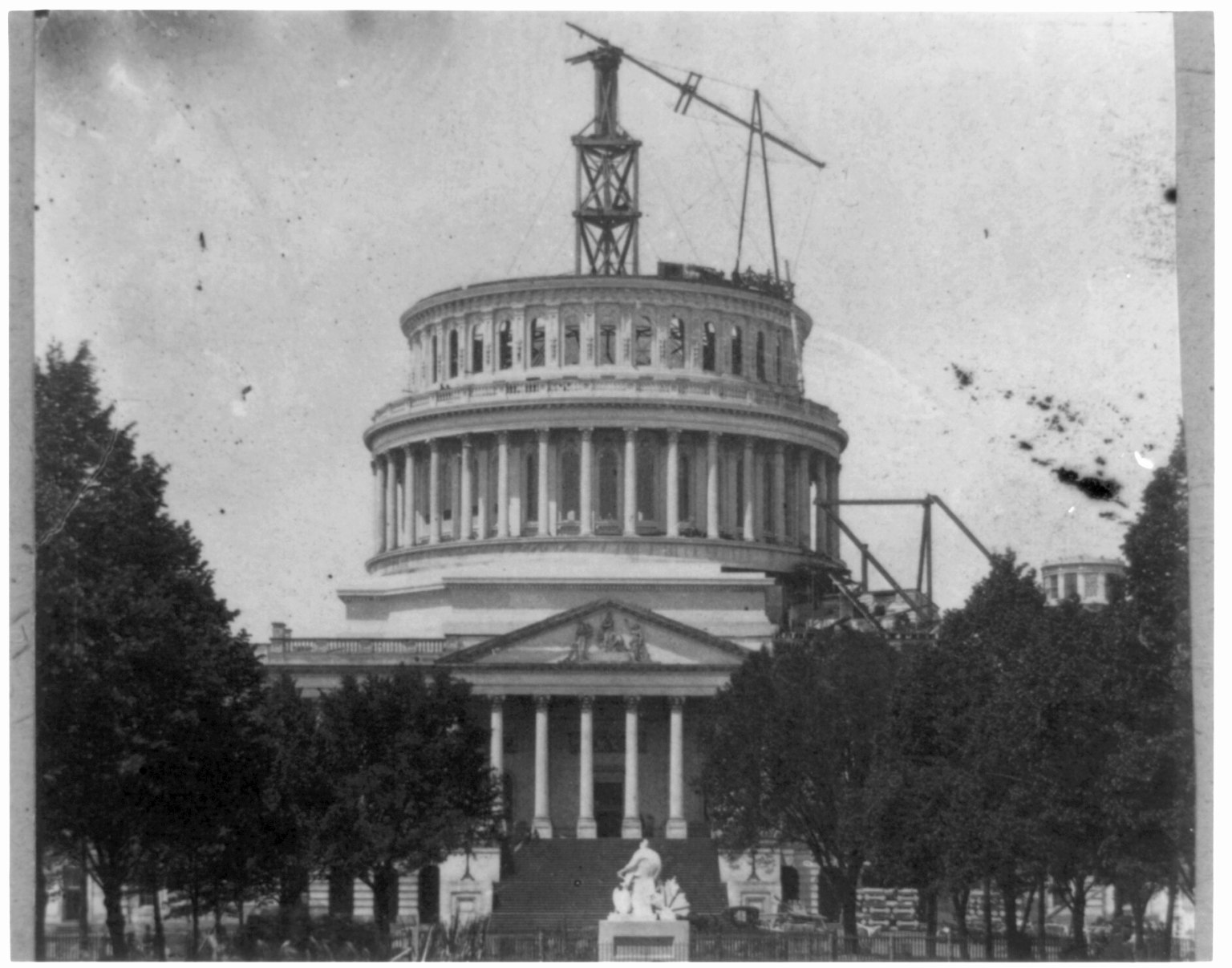
The cast-iron dome under construction in 1861, with the old low dome still inside the scaffold. Library of Congress, public domain, via Wikimedia Commons. Resized.
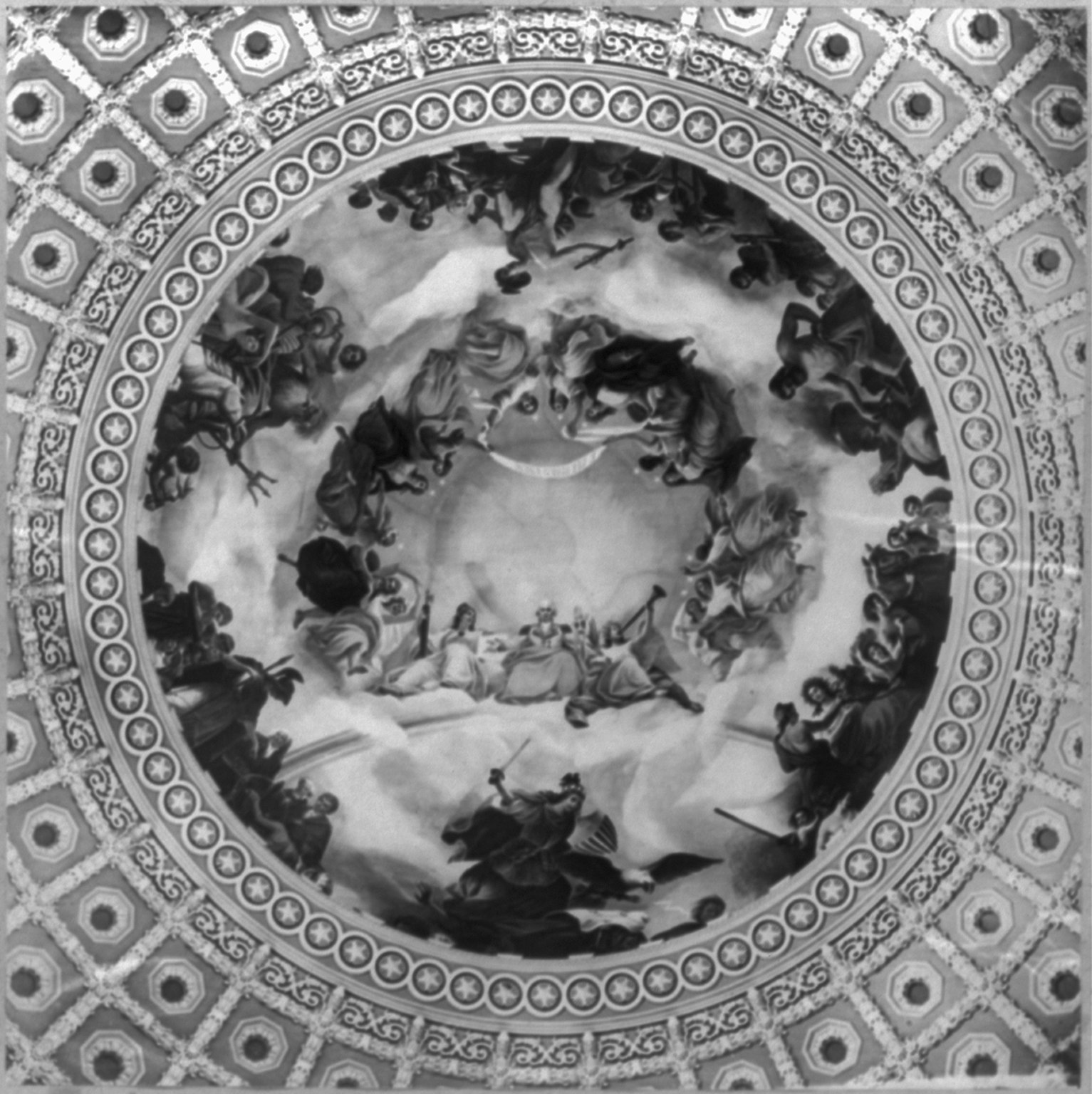
Constantino Brumidi's The Apotheosis of Washington in the eye of the Rotunda. Public domain, via Wikimedia Commons. Resized.
The modern Capitol
In 1958-1962 the East Front was extended 33.5 feet out in marble; the original 1828 sandstone columns were removed and eventually re-erected at the National Arboretum as the National Capitol Columns. The biggest modern addition is invisible from the Mall: the Capitol Visitor Center, a 580,000-square-foot underground complex that opened on December 2, 2008, with an exhibition hall, theaters, gift shops and a restaurant. Between three and five million people visit the Capitol each year. In 1960 the building was declared a National Historic Landmark.
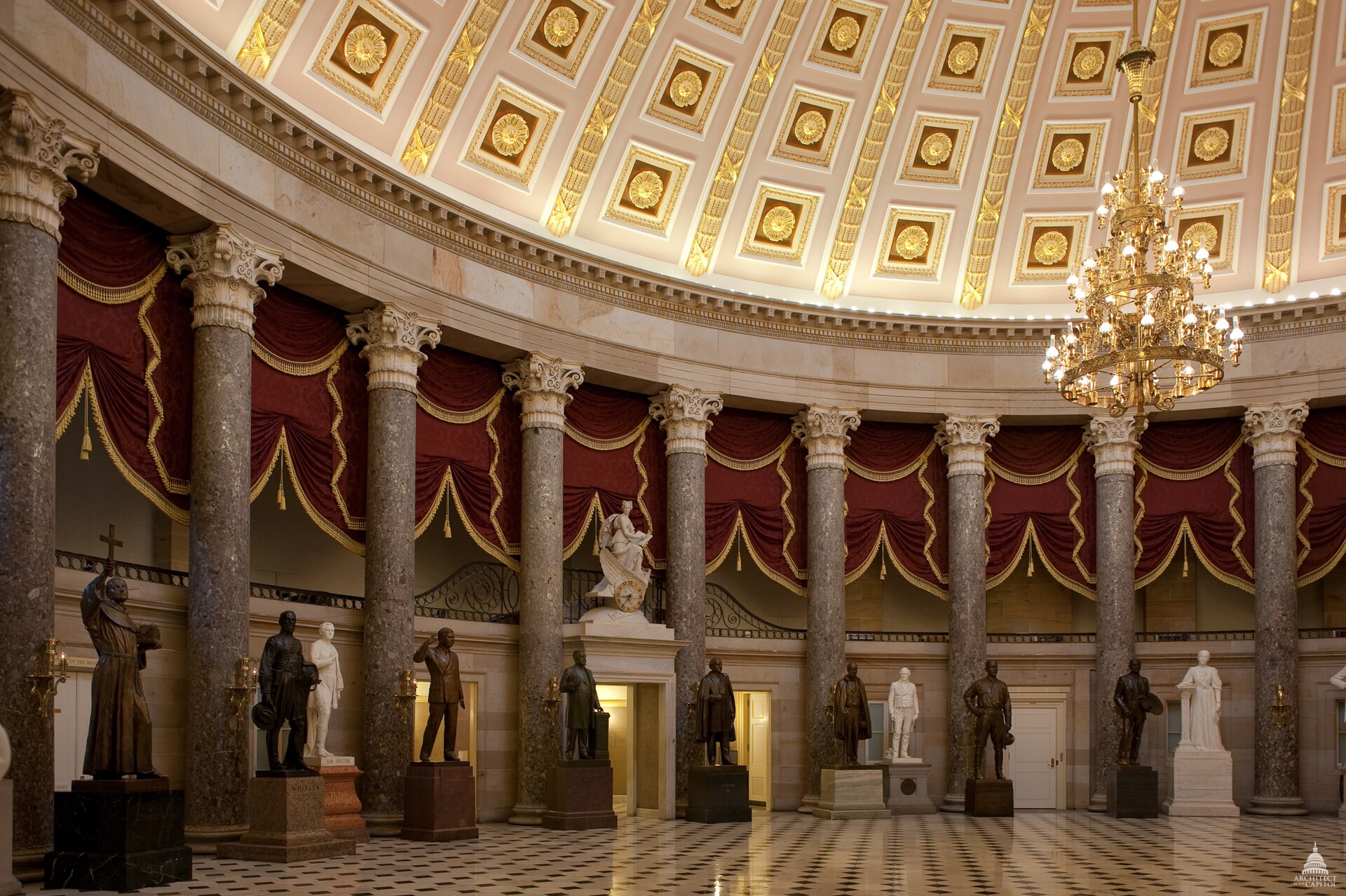
National Statuary Hall, the semicircular chamber where the House met from 1819 to 1857. Photo: USCapitol, public domain, via Wikimedia Commons. Resized.
Who owns the U.S. Capitol today?
The Capitol is owned by the United States and cared for by the Architect of the Capitol, the federal office responsible for the building and grounds since 1793. It remains a working legislature first: the Senate and House chambers sit in the north and south wings, and flags fly over both when either body is in session.
In the movies
Hollywood almost never gets inside the real Capitol, so its famous "Capitol" interiors are replicas. For Mr. Smith Goes to Washington (1939), Frank Capra recreated the Senate chamber on a Columbia Pictures soundstage with advice from James Preston, the 40-year superintendent of the Senate press gallery, while Washington exteriors - the real Union Station among them - played behind rear projection. Since then the dome has become shorthand for Washington itself, appearing as an exterior in countless films and television titles; what you see on screen inside is nearly always a set.
Where can you eat or drink at the U.S. Capitol?
The Capitol Visitor Center has a public restaurant, the Capitol Cafe, on its lower level - the only dining inside the building open to visitors. All Capitol tours, exhibits and programs are free. (Hours read November 5, 2026; confirm before visiting.)
Visiting the U.S. Capitol
- Address: First St SE, Washington, DC 20004
- Hours: Monday-Saturday, 8:30 AM-4:30 PM
- Admission: Free (reserve passes online)
The Capitol Visitor Center is the public entrance. Same-day passes are often available, but booking a tour in advance is the safer bet. The grounds are open dawn to dusk.